In a nutshell
- 🌿 Vinegar’s acetic acid delivers a non-selective contact burn that dehydrates foliage fast—often visible within hours—ideal for paths and gravel, but roots may survive, so repeat or pull after scorching.
- ⚗️ Match strength to the job: 5% household vinegar for seedlings; 10–20% horticultural for tougher weeds; use PPE, add a tiny surfactant (washing-up liquid), and never mix with bleach.
- 🎯 Apply on a dry, still, sunny day; shield ornamentals; spray low for light, even coverage, not puddles; early evening treatments often yield overnight collapse; reassess in 24 hours and repeat in 3–5 days if needed.
- ⚠️ Know the limits: it’s non-selective (scorches lawns and edibles), high strengths can irritate eyes/lungs and corrode surfaces, and adding salt harms soil life—avoid drift and protect nearby plants.
- 🌱 Pair with eco tactics: lay 5–8 cm mulch, hoe on sunny days, try flame weeding on gravel, use polymeric sand in joints, and rely on dense planting and hand-pulling to reduce future weed pressure.
It sounds almost folkloric: point a spray bottle at a patio crack at dusk, and by morning the unruly green interlopers have flopped, dulled, and are ready to pluck. The trick is not sorcery but vinegar—specifically, its acetic acid—which dehydrates tender growth quickly without resorting to synthetic herbicides. Gardeners across Britain increasingly favour this low-cost, low-tox route for paths, driveways, and veg-bed edges where precision matters. Results can be startlingly fast. Not magic, though. Understanding what vinegar does, where it shines, and where it falls short is essential. Used wisely, it’s a sharp, targeted tool; used carelessly, it’s blunt and unforgiving.
Why Vinegar Works on Weeds
Vinegar’s punch comes from acetic acid, which disrupts plant cell membranes and pulls moisture from soft tissues. The effect is visible: gloss turns to grey-green, leaves crumple, and stems soften. In warm, bright weather, you can see wilt within hours and dramatic collapse by the next morning. That speed is why patios, gravel paths, and veg-plot borders are ideal battlegrounds for this method. It’s a contact, non-selective approach: what it touches, it scorches, irrespective of species.
There’s a catch. Vinegar is not a systemic herbicide. It does not ride the sap to roots. Direct contact kills; roots often survive. Annual seedlings and young taproots succumb readily, but mature perennials—dandelion, dock, couch grass—tend to re-sprout from underground stores. That doesn’t make vinegar futile; it reframes its role. Use it to knock back top growth fast, then pull or repeat to exhaust reserves. Sun and dry air amplify the effect; rain dilutes it. Wind spreads droplets to treasured plants, so pick still days. Precision, not power, is the winning habit here.
Choosing the Right Acetic Acid Strength
Household white vinegar typically sits at 5% acetic acid. It’s kinder to surfaces and safer to handle, excellent for seedlings and small annuals. For tougher targets, gardeners often step up to horticultural vinegar at 10–20%. That escalation brings brisker burn but also real risk: skin and eye irritation, metal corrosion, and stronger fumes. Always wear gloves and eye protection at higher strengths. A drop of washing-up liquid (as a surfactant) helps the spray cling and spread. Skip the salt: it boosts scorch but harms soil life and lingers in beds and borders.
The table below compares common options so you can match strength to the job, not bravado. One immovable rule applies across the board: Never mix vinegar with bleach. The reaction releases toxic chlorine gas. If in doubt, stick to clean water, vinegar, and a modest squirt of soap, then test on a small patch before scaling up your offensive.
| Vinegar Type | Acetic Acid | Best Use | Time to Visible Effects | Notes |
|---|---|---|---|---|
| Household white vinegar | ~5% | Seedlings, young annual weeds | 2–24 hours | Low risk; repeat may be needed |
| Horticultural vinegar | 10–15% | Established annuals, fresh perennial regrowth | 1–12 hours | Wear PPE; avoid drift |
| High-strength horticultural | 20% | Cracks, paving, gravel | 1–6 hours | Very caustic; not for lawns or beds |
Safe, Targeted Application: Step-by-Step
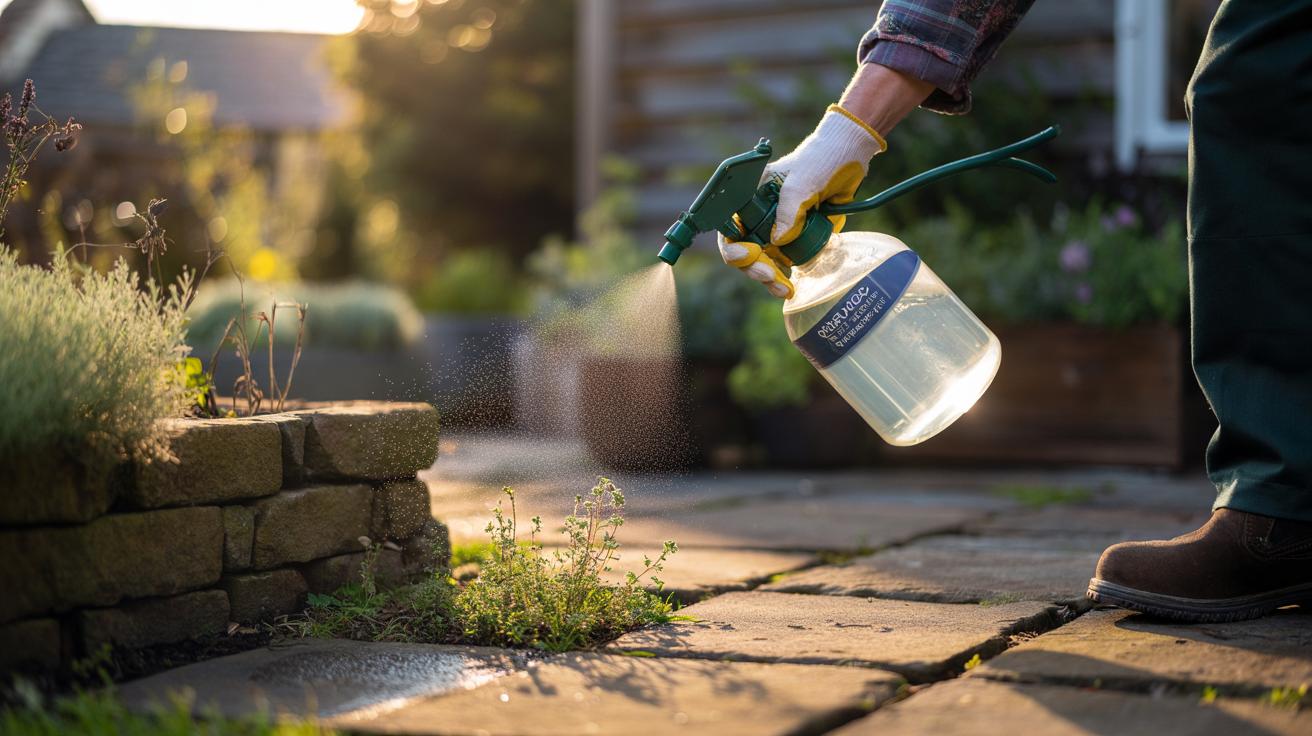
Pick a dry, bright day with minimal wind. Sunshine accelerates desiccation; rain blunts it. Decant your chosen vinegar into a clean sprayer and add a tiny dash of washing-up liquid—about half a teaspoon per litre—to help it stick. Label the bottle. Shield nearby ornamentals with cardboard or a piece of plywood; this is a non-selective treatment, and roses won’t appreciate an accidental misting.
Spray close and low. Aim for glistening coverage on leaves and tender stems, not puddles. On paving or gravel, trace the crown of the weed and any green you can see; in borders, spot-spray only what you intend to kill. Early evening applications reduce evaporation and can produce those vaunted “overnight” results by morning. Check back after 24 hours. If the top growth is crisp and brown, pull cleanly—roots come easier then. If life lingers, repeat in three to five days. Two or three cycles often exhaust small perennials. Rinse your sprayer and store it clearly marked for vinegar use only.
Limits, Risks, and Eco-Savvy Alternatives
Vinegar excels on hardscapes and bare soil edges but is clumsy inside lawns or densely planted beds. It will scorch grass as readily as goosegrass. Do not spray when drift could reach edibles or pollinator-friendly planting. High-strength acetic acid can irritate lungs and eyes; gloves, goggles, and sleeves are not theatre, they’re prudent. Surfaces matter too: frequent use can dull some metals and stain certain natural stones. As for soil, acetic acid breaks down quickly, but repeated, salty mixes (best avoided) can wound the microscopic workforce you rely on.
When vinegar isn’t the right tool, reach for complementary tactics. Mulch 5–8 cm deep to smother light-hungry seedlings. Hoe on sunny days to desiccate uprooted threads. Try flame weeding on gravel paths—briefly blister the foliage; don’t cook the soil. In paving joints, replace crumbling sand with polymeric sand to deny seeds a foothold. For beds, dense planting and groundcover reduce bare soil, cutting weed recruitment at source. Hand-pull perennials after rain when roots slip free. Think of vinegar as a smart first strike, embedded in a broader, chemical-light strategy.
Used with intent and care, vinegar can make misbehaving weeds vanish almost as quickly as they arrived, delivering fast visual wins and cleaner lines along paths and patios. It’s cheap, accessible, and—crucially—transparent in what it does: a contact burn with no lingering mystery in the soil. Yet every garden is a patchwork of contexts, from herbaceous borders to children’s play areas, each demanding its own balance of speed, selectivity, and safety. How will you blend vinegar’s sharp shock with longer-term tactics to keep your plot tidy without leaning on harsh chemicals?
Did you like it?4.6/5 (24)